Legal Advisory for Carbon Markets, Climate Finance and Environmental Markets in India.
A specialised legal practice advising on the regulatory, transactional and contractual dimensions of carbon markets, climate finance and environmental markets in India, with an additional practice in Indirect Tax.
Carbon market legal advisory, across the transaction.
Carbon Market Regulatory Advisory
Regulatory and compliance advisory on the Indian Carbon Market and the Carbon Credit Trading Scheme, including policy interpretation and environmental market regulations.
Carbon Transactions & Commercial Contracts
Transaction structuring and legal documentation for carbon credit transactions, including ERPAs, sale agreements, offtake, aggregation and revenue sharing arrangements.
Carbon Asset Due Diligence
Legal due diligence on carbon assets - ownership opinions, title verification, and transaction risk review ahead of a carbon credit transaction.
Carbon Project Structuring
Legal structuring of carbon projects, climate finance documentation, and the frameworks governing how carbon revenue is shared among participants.
Government & Institutional Advisory
Legal advisory to municipal bodies, smart city authorities and institutions on carbon monetisation frameworks, tenders, RFPs and procurement documentation.
Carbon Market Dispute Resolution
Commercial and contract disputes arising from carbon transactions, arbitration, and regulatory proceedings before the applicable forum.
Indirect Tax
A secondary practice in GST and Customs advisory and litigation, including matters before CESTAT and the GST Appellate Tribunal.
Why carbon markets need specialist legal counsel.
Carbon markets sit at the intersection of environmental regulation, contract law, and cross-border commercial practice. India's Carbon Credit Trading Scheme is a relatively new regulatory framework, and international mechanisms - including Article 6 of the Paris Agreement and the EU's Carbon Border Adjustment Mechanism - continue to evolve.
Carbon credits are also a novel form of legal asset: their ownership, transferability and value depend on the accuracy of the underlying legal documentation.
For project developers, corporates and institutions operating in this space, that combination of regulatory novelty, cross-border complexity and transactional risk calls for legal advisory that understands how the pieces fit together - not general commercial counsel applied to an unfamiliar sector.
Anonymised summaries of matters handled by the practice.
The engagements described are illustrative summaries and do not identify any client. Past engagements do not guarantee similar outcomes in future matters.
Sectors the practice advises.
- Renewable Energy
- Agriculture
- Biochar
- Forestry
- Waste Management
- Manufacturing
- Municipal Bodies
- Smart Cities
- Climate Technology
- ESG Platforms
- Carbon Project Developers
- Carbon Credit Buyers
- Institutional Investors
- Development Finance Institutions
- NGOs and Foundations
Writing on carbon market regulation and climate law.
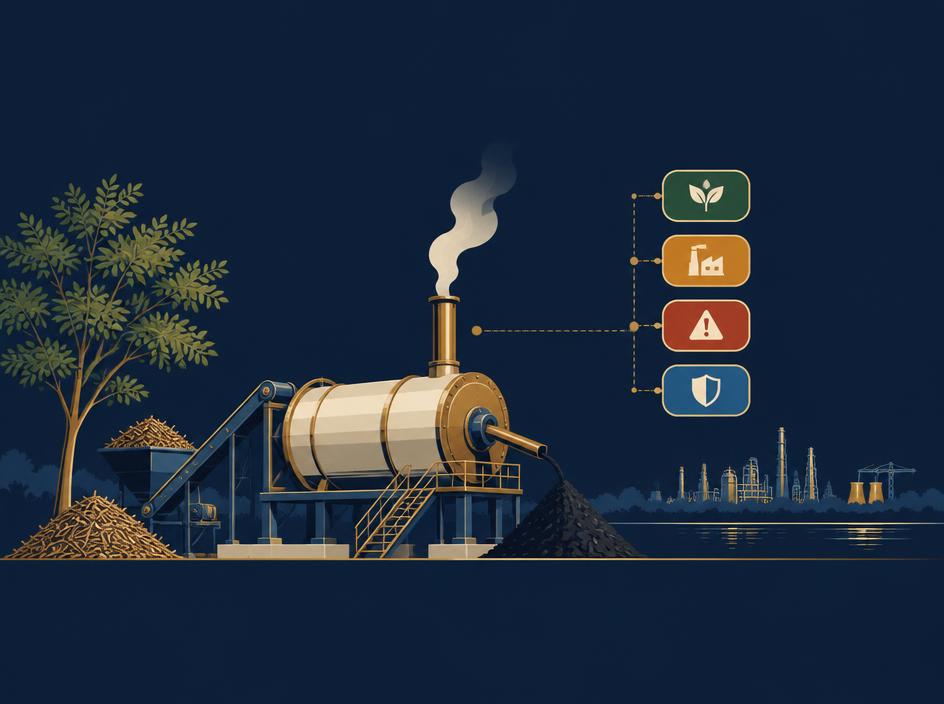
Which CPCB Category Does a Biochar Plant Fall Under? Reading the Charcoal Manufacturing Analogue
CPCB's sector-categorisation directions contain no explicit entry for biochar. Reading the residuary classification route alongside the charcoal manufacturing entry suggests how a pyrolysis-based biochar plant is likely to be categorised, and why the answer turns on kiln type and capacity.

UK CBAM Recognises India's CCTS: What It Actually Delivers for Exporters
The UK has recognised India's Carbon Credit Trading Scheme as a qualifying carbon pricing mechanism under its CBAM, effective 1 January 2027. The recognition opens a door, but walking through it takes documentation, verification and reliable emissions data.

India's Artisan Biochar Sector: Three Legal Questions Every Project Must Answer
Artisan biochar projects can get all three of their core legal questions wrong while appearing to operate perfectly well. Facility legality, carbon ownership and monetisation are separate questions, and a project design document answers none of them.
Speak with counsel on a carbon market matter.
For regulatory advisory, transaction structuring, legal documentation or due diligence, write to the practice directly.